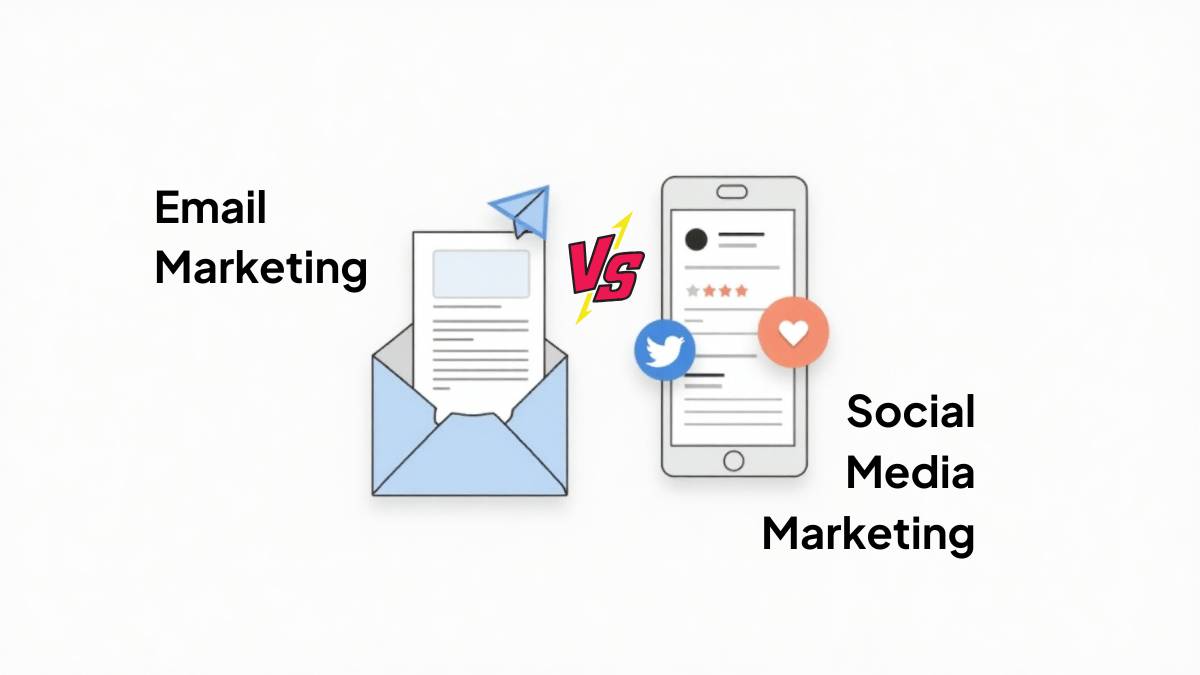
It's a comparison most content marketers eventually run, formally or not: send the same offer to an email list and post it to social media on the same day, then compare what actually converts. The intuitive expectation is that social wins on sheer reach and email wins on conversion, landing somewhere in a balanced "both channels matter" conclusion.
In practice, the result is usually far more lopsided than that. A list a fraction the size of a combined social following will routinely outperform social by an order of magnitude on same-day, same-offer conversions — same message, same timing, a social audience more than double the size, and the result still isn't close. The data from 2026 only reinforces the point more sharply.
The ROI Numbers: What the Data Actually Says
Email marketing delivers an average return of $36 to $42 for every $1 spent, according to data from Litmus and multiple industry studies updated through 2026. For e-commerce specifically, where abandoned cart and post-purchase flows can be fully automated, the figure climbs to $45 per $1 spent. Social media advertising, across all platforms, averages around $2.80 per $1 spent. Facebook ads specifically have dropped from roughly $4 per $1 just a few years ago to about $1.75, according to Sender.net's 2026 data, as the platform becomes more saturated and ad costs continue climbing.
That ROI gap — roughly 10 to 15 times higher for email than for paid social — is not a fluke or an artifact of measurement methodology. It reflects a structural difference in how the two channels work. With email, you're reaching people who explicitly opted in to hear from you, at a time when they're in an inbox-checking mode, with a message that lands directly without algorithm interference. With paid social, you're interrupting people mid-scroll with content they didn't ask for, competing against thousands of other advertisers for the same attention.
Email vs Social: The 2026 Numbers
The conversion rate comparison deserves particular attention. Email converts at 4.24% for purchases, according to Statista's 2025 research. Search traffic converts at 2.49%. Social media traffic converts at just 0.59%. Email is seven times more likely to convert to a purchase than a visitor arriving from social media. When 50% of consumers reported in 2024 that they had purchased directly from an email, compared to a much smaller fraction from social media posts or ads, that's not a channel preference quirk. It's the natural outcome of communicating with someone who wants to hear from you versus broadcasting to someone who's trying to watch a friend's video.
Why Social Media Wins at Things Email Can't Do
Before anyone accuses me of being unfairly pro-email: social media is genuinely better at several things that matter, and ignoring those would be bad advice.
Social media wins at discovery and new audience reach. You can't email someone who doesn't know you exist yet. Social media, particularly organic content on TikTok and Instagram Reels, can put your brand in front of completely cold audiences who have never heard of you. This top-of-funnel reach is social's primary superpower. A Reel that goes viral can grow your audience by thousands of followers in a week. No email campaign does that.
Social media wins at brand awareness and cultural relevance. Being present on social platforms where your audience spends time creates ambient brand familiarity that email can't replicate. Someone who sees your Instagram content three times a week for two months is warm before they ever subscribe to your email list. Social media is often the mechanism by which people decide you're worth giving their email address to.
Social media wins at real-time engagement and community building. The comments section, the DMs, the live sessions, the polls and Q&As — these are forms of interaction that email's one-to-many format can't match. If you're trying to build a community around your brand rather than just sell products, social platforms provide infrastructure that email doesn't have.
And social media still drives significant commerce, particularly for impulse purchases. 81% of consumers are influenced by social media to make impulse purchases, and social networks drove 17.11% of total online sales in 2025. The sales happen, they're just lower-ROI on average because you're paying to reach people who didn't raise their hand.
The Channel That Wins Depends on What You're Trying to Do
| Goal | Better Channel | Why |
|---|---|---|
| Convert existing leads to buyers | Opt-in audience, direct message, no algorithm friction | |
| Reach brand-new cold audiences | Social | Algorithmic distribution to non-followers, virality potential |
| Retain existing customers | Post-purchase sequences, loyalty programs, personalized follow-ups | |
| Build brand awareness at scale | Social | Passive exposure through feeds, no inbox required |
| Drive event registrations or launches | Direct urgency, segmentation by interest, high open rates | |
| Product discovery for new customers | Social | Shopping features, influencer recommendations, visual discovery |
| Nurture leads over time | Automation sequences, behavioral triggers, personalization | |
| Community building | Social | Comments, DMs, groups, live interactions |
The pattern in that table makes the ideal strategy obvious: use social media to find new people and bring them into your world, then use email to convert them and keep them. Not email vs social media. Email because of social media.
The Integration That Actually Works
The businesses I've seen grow most consistently in 2026 treat social media as a list-building engine, not a sales engine. Every Reel, every tweet, every LinkedIn post is designed with one secondary goal beyond content value: get people onto the email list. The post is the awareness. The email is the conversion.
Practically, this means including a clear CTA that points to a lead magnet in every piece of social content that performs well. It means using link-in-bio tools like Stan Store or Beacons to funnel social traffic directly into an email sign-up sequence. It means running "download this free guide" or "join the challenge" campaigns that use social's reach to build email's list. And it means tracking the path: how many email subscribers came from social, and what's the revenue attribution from that cohort?
One e-commerce brand I advised made this their core Q1 2026 strategy. They ran a series of TikTok tutorials showing how to use their product, with every video ending with "link in bio for the full guide." The guide was gated behind an email sign-up. In 90 days, they added 6,200 new email subscribers from TikTok. Those subscribers generated $84,000 in revenue over the following six months through automated email sequences, at a fraction of the cost of running equivalent paid social campaigns targeting cold audiences. The TikTok content itself was free to make.
The Ownership Argument: Why This Is Really About Risk
There's a dimension to this debate that rarely gets discussed as directly as it should: ownership. Your email list is yours. Your social following is rented. Instagram can throttle your organic reach tomorrow with an algorithm update. TikTok can be banned in your country. Meta can increase ad prices to the point where your campaigns stop being profitable. All of these things have happened to real businesses in the past five years.
An email list, by contrast, can't be algorithmically throttled. The platform doesn't control your reach to the people who signed up. You can export your list, move it to a different email service provider, and continue reaching those people with zero interruption. You own that relationship in a way you never own a follower relationship on a social platform.
This isn't just a philosophical point. It's a business continuity argument. Businesses that rely entirely on social media for revenue are one algorithm change or policy update away from a significant problem. Businesses with email lists as their primary revenue channel are much more resilient. The brands I've seen weather repeated social platform disruptions in recent years all had strong email lists. The ones that didn't had to scramble.
Which One Should You Invest More In Right Now?
My direct answer, having watched this play out across dozens of businesses: if you have to choose where to put your limited time and money, put it into building your email list first. The ROI is higher, the conversions are higher, the ownership is real, and the compounding effect of a growing engaged list is more predictable than social algorithm changes.
But don't abandon social. Use it as the fuel that grows your list. Every social platform is an opportunity to find someone who doesn't know you yet and move them one step closer to your email list. The goal of social isn't to sell from a post. The goal of social is to earn the right to a subscriber's inbox. Once you have that, email takes over.
The businesses that will dominate their niches in 2026 and beyond aren't choosing between email and social. They're using social to build the list, then using email to build the revenue. That combination, done intentionally and consistently, is the highest-ROI marketing system available to any online business right now.
The one metric that changes everything: If you're not tracking what percentage of your revenue is attributable to your email list versus social channels, you're flying blind on this decision. Set up proper UTM tracking, attribute email revenue in your analytics, and run the comparison for 90 days. The data will tell you exactly where to invest more.