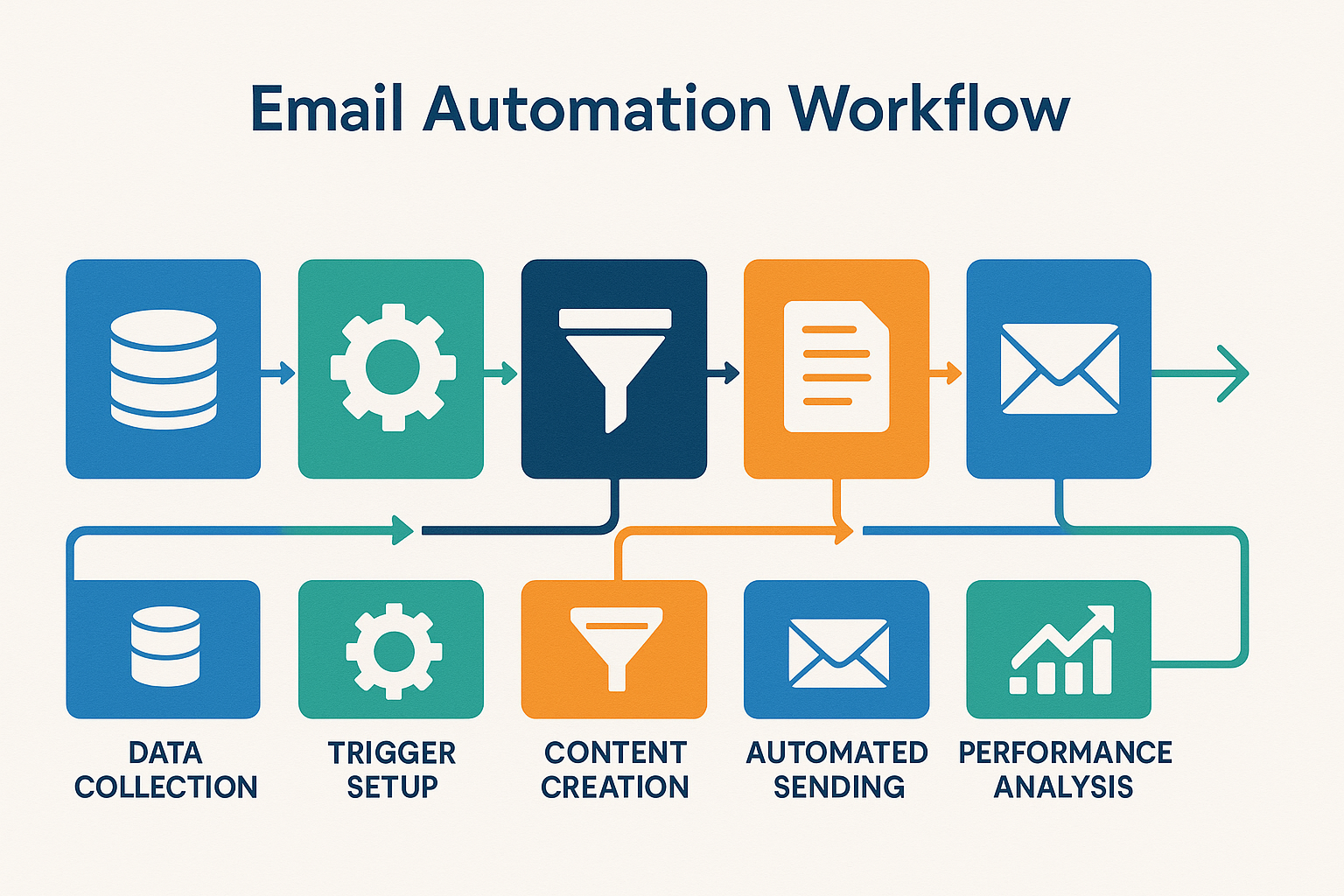
The number that permanently changed how I think about email marketing: automated emails represent just 2% of total email volume but generate 30% of all email revenue, according to Omnisend's 2025 email marketing research. Let that sit for a second. Two percent of the emails you send could be responsible for nearly a third of everything your email list earns you. That's not a marginal efficiency gain. That's a structural insight that should completely change where you spend your email marketing time.
When I first looked at this stat seriously, I audited my own setup and realized I was spending 80% of my email time crafting and sending broadcast newsletters, which were accounting for maybe 40% of my email revenue. The automation workflows I'd set up years earlier and largely forgotten about were quietly generating the other 60%, around the clock, without me touching them. That was the moment I stopped treating automation as a nice-to-have and started treating it as the core of the email strategy.
Here are the 10 workflows I'd build for any online business starting from scratch today, in order of priority, with the exact structure that works.
Email Automation: The Performance Numbers
Start Here: Build These Three First
If you have nothing right now, don't try to build all ten sequences at once. Start with the three that cover the highest-leverage moments in any subscriber relationship: the welcome series, the abandoned cart sequence, and the re-engagement campaign. Together, they cover first impressions, active purchase intent, and audience health. Everything else adds value on top of this foundation.
Your welcome series has the highest open rates of any email sequence you'll ever send. Welcome emails generate an average 84% open rate. That's not a typo — it's the natural result of sending someone an email at the exact moment they've expressed interest. Most businesses waste this window by sending one generic "Thanks for subscribing!" email and then dropping new subscribers straight into their regular broadcast cadence.
A 5-email welcome series built over 7 days is the structure I return to for nearly every business type. Email 1 delivers the promised lead magnet or welcome offer immediately. Email 2 (24 hours later) introduces the brand story and what makes you different. Email 3 (Day 3) leads with social proof — testimonials, case studies, or notable results. Email 4 (Day 5) delivers genuine educational value, the most useful piece of content you have. Email 5 (Day 7) makes a clear, time-sensitive offer with a direct CTA. The 2026 version of this adds a branching question in email 2 — a one-click poll asking what the subscriber is most interested in — then delivers emails 3 through 5 in slightly different versions based on the answer. That branching structure drives 30–40% higher click rates on the offer email.
70.19% of online shopping carts are abandoned before purchase, according to Baymard Institute data. A 3-email abandoned cart sequence recovers 15 to 25% of those abandonments. That means for every $100 you're currently losing to cart abandonment, a properly built automation flow brings back $15 to $25 without additional ad spend. For most e-commerce brands, this single workflow pays for their entire email platform cost many times over.
- Email 1 (1 hr) Gentle reminder: "Did you forget something?" Include product image, name, price, and a direct link back to the cart. No pressure. No discount yet.
- Email 2 (24 hrs) Social proof focus: customer reviews or photos of the specific abandoned product. Add a mild urgency element if inventory is genuinely limited.
- Email 3 (72 hrs) Incentive offer: free shipping or a 10% discount code with a clear expiration. Only send this third email if they haven't purchased after the first two.
Most email marketers ignore subscribers who stop opening emails. They just keep sending to them, which tanks deliverability across the whole list. A structured win-back sequence gives unengaged subscribers a genuine reason to re-engage before you clean them off the list. The goal isn't to guilt them into opening — it's to either re-activate their interest or get a clean opt-out that protects your sender reputation. Email 1 asks simply "Are we still relevant to you?" with a preference update link. Email 2 shares your best-performing content from the last 90 days. Email 3 makes a special offer exclusive to people who've been quiet for a while. Email 4 is the goodbye: "We're going to remove you from our list unless you click here to stay." This final email often has a surprisingly high click rate because people realize they do want to stay.
The Next Four: Add Once Your Foundation Is Solid
Most businesses treat the purchase confirmation email as the end of the conversation. It's actually the beginning of the most valuable relationship you can build: a paying customer who chose you. Post-purchase nurture turns one-time buyers into repeat customers. The sequence should confirm the purchase and set delivery expectations (Email 1), then deliver product usage tips or best practices that help them get maximum value from what they bought (Emails 2 and 3), then follow up 14 days in with a satisfaction check that doubles as an upsell or cross-sell opportunity (Email 4), then ask for a review or testimonial at day 21 when they've had time to form an opinion (Email 5).
Not everyone who subscribes is ready to buy immediately. The lead nurture sequence keeps non-buyers engaged with genuinely useful content while slowly moving them toward a purchase decision. Structure it as an educational journey: each email teaches something specific about the problem your product or service solves. Intersperse case studies. Ask questions that prompt replies and segmentation. Make a softer offer every third or fourth email. The goal is to be the most useful brand in their inbox so that when they're ready to buy, you're the obvious choice. For B2B businesses, this sequence should include a case study, an industry insight email, and a direct invitation for a consultation or demo.
Browse abandonment is less aggressive than cart abandonment and requires more subtlety. Someone who visited a product page twice is researching, not necessarily intending to buy. The first email (sent 24 hours after the second visit) should acknowledge their interest without being creepy about tracking: "Noticed you were checking out [Product Category] — here's what our customers say about it." No hard sell. The second email (48 hours later) answers common objections for that product category. If there's no engagement after two emails, stop the sequence.
Your best customers deserve a different experience from first-time buyers. A VIP recognition sequence triggers when someone hits a purchase or spending threshold and acknowledges their loyalty with something tangible: early access to new products, an exclusive discount tier, a personal thank-you email from the founder, a gift with their next order. The psychology here is powerful — people who feel recognized as valued customers spend more and refer more than those who receive identical treatment to everyone else. Use tags in your email platform to identify VIP subscribers and route them to content and offers that reflect their status.
The Final Three: For Mature Email Programs
An upsell sequence fires after a specific purchase and recommends the natural next product in the customer's journey. Someone who buys a beginner course gets an email series about the advanced course 14 days later. Someone who buys a base product gets emails about the premium version or compatible accessories. The key is timing — this sequence should start after the post-purchase nurture establishes value, not immediately after the sale. If someone hasn't had a chance to use what they bought, they're not ready to hear about the next thing.
A single personalized email sent on the anniversary of a subscriber's first purchase or their birthday consistently achieves open rates 40–60% above standard broadcast emails. The message is simple: acknowledge the milestone, offer something meaningful to celebrate it. This doesn't require a massive discount — a heartfelt note from the founder plus free shipping on their next order performs as well as a 20% off code in most tests I've run. The personalization signal alone drives the engagement.
Happy customers are your best acquisition channel, but they rarely refer unless prompted at the right moment. A referral trigger fires 30 days after a purchase, after the customer has had time to experience the product and form a positive opinion. The email should make referring easy: a personal share link, a clear incentive for both the referrer and the new customer, and a simple ask that doesn't feel transactional. Platforms like ReferralCandy and Friendbuy integrate with most email platforms to automate the referral tracking side of this workflow.
The Platform Question: What Actually Runs These Well
Not all email platforms handle behavioral triggers with the same sophistication. For e-commerce, Klaviyo is the industry standard for a reason: its Shopify and WooCommerce integrations are deep, the abandoned cart and browse abandonment triggers are native, and the segmentation is among the best available at any price point. For creator businesses and SaaS, Kit handles the tagging and conditional logic that powers branching sequences cleanly. ActiveCampaign is the most powerful option for complex B2B customer journey mapping, with CRM integration that makes lead scoring and sales handoff seamless.
Build your sequences in whatever platform you're on, but don't let platform choice be the excuse for not starting. Even basic platforms support welcome series, abandoned cart (if connected to your store), and re-engagement triggers. Start with what you have. The workflows matter more than the tool you use to run them.
The mistake that kills automation performance: Building workflows and never revisiting them. Automation sequences decay over time as market context changes, offers expire, and audience expectations shift. Review each sequence every 90 days. Check open rates and click rates against the benchmarks above. Replace any email consistently underperforming those benchmarks. This maintenance habit is what separates email programs that compound over time from ones that plateau.