Search advertising is undergoing its most significant structural change since Google launched AdWords in 2000. The change isn't incremental. AI-powered search engines are processing queries differently, surfacing results in conversational formats that don't look like the ten blue links advertisers have been optimizing for since the beginning of search engine marketing.
Google's AI Overviews, which appear in the majority of search results pages in 2026, have changed where users' eyes land. ChatGPT, now handling hundreds of millions of queries daily, is beginning to integrate sponsored results. Perplexity is monetizing through sponsored follow-up questions. The playbook written for keyword-based text ads in standard search pages is being rewritten in real time, and advertisers who understand the new environment early have a meaningful advantage over those waiting for the dust to settle.
Google AI Max: What It Is and How It Changes Campaigns
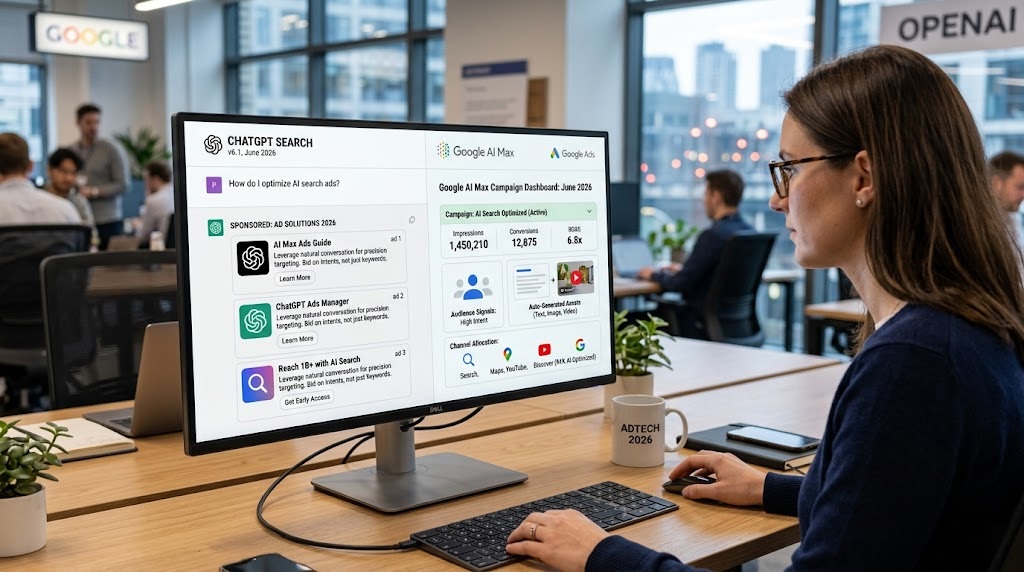
Google's AI Max is a new campaign enhancement layer rolled out in 2026 that sits on top of existing Search campaigns. Rather than replacing manual keyword targeting, AI Max expands it using AI to identify additional relevant queries that your existing keyword structure would miss. When enabled, it allows Google to match your ads to queries semantically related to your keywords even when those exact phrases aren't in your keyword list.
The most significant feature in AI Max for advertisers is URL expansion: Google can now serve ads to users and direct them to the most relevant landing page on your site for their specific query, rather than always the landing page you manually specified in the campaign. For sites with multiple relevant pages (e-commerce stores, service businesses with multiple offerings), this can meaningfully improve conversion rates because the destination matches intent better. For advertisers with carefully crafted single landing pages, it requires monitoring to ensure Google isn't routing traffic to pages with weaker conversion optimization.
AI Max also includes final URL expansion controls and custom parameters that let advertisers maintain more granular control than Performance Max while still benefiting from AI query expansion. The practical advice: enable AI Max on your best-performing Search campaigns, monitor the new query categories it unlocks in the search terms report for the first two weeks, and add negatives for any irrelevant expansions immediately. The upside in additional volume can be significant; the downside is managed through active negative keyword maintenance.
ChatGPT Ads: What We Know About the Emerging Format
OpenAI began testing sponsored results inside ChatGPT in late 2025, with wider rollout continuing through 2026. The format is fundamentally different from traditional search ads in ways that matter for advertisers.
In traditional search ads, a user types a keyword and sees a list of ads alongside organic results. They choose which to click. In ChatGPT ads, the AI generates a conversational response to the user's query, and sponsored content is integrated into that response in a contextually relevant way. The user is reading a paragraph of AI-generated content when a product or service recommendation appears. Early reports from beta advertisers suggest that ChatGPT ads generate significantly higher engagement rates than traditional search ads because the context of a conversational AI recommendation carries implied trust — the user is in a receiving mode from a trusted AI assistant, not in a skeptical mode from knowing they're being advertised to.
The challenge for advertisers: traditional keyword-based campaign management doesn't map cleanly to conversational AI queries. A user asking ChatGPT "I'm planning a bathroom renovation for a 1920s house, what should I prioritize?" is expressing commercial intent relevant to contractors, tile suppliers, and renovation product brands — but their query doesn't contain any of the keywords those advertisers are bidding on in Google Search. AI search advertising is inherently intent-based rather than keyword-based, and the tools for buying and optimizing it are still maturing. Advertisers interested in ChatGPT's advertising program should monitor OpenAI's advertising developer documentation for access.
Perplexity and the Emerging AI Search Ad Ecosystem
Perplexity, the AI-powered research assistant, introduced a sponsored follow-up questions format in 2025. When a user asks a question and Perplexity provides an answer, suggested follow-up questions may include sponsored prompts that lead users toward product categories or specific offerings. For brands whose products are naturally embedded in research journeys (software tools, professional services, physical products with research-heavy buying processes), this format can place the brand at exactly the moment of decision-making research.
The cumulative picture of AI search advertising in 2026: Google AI Overviews have reduced click-through rates on traditional search results but introduced new ad placements within the AI answer itself. ChatGPT ads are in controlled rollout and beginning to offer new reach with a conversational format. Perplexity sponsored content is available to selected advertisers. Collectively, these platforms are creating a new category of AI-native advertising that rewards relevance and context over pure keyword bidding.
How to Adapt Your Paid Search Strategy for AI Search in 2026
The brands winning in AI search advertising in 2026 share a common thread: they've invested in brand authority and content depth that makes them credible enough to be cited or recommended by AI systems, not just ranked for keywords. This is the intersection of SEO, content marketing, and paid advertising that is becoming the defining challenge of the next phase of digital marketing.
For traditional Google Ads advertisers, the immediate practical steps are: enable Google AI Max on your Search campaigns to capture the query expansion benefit while maintaining keyword control; monitor AI Overview placements in your Google Search Console to understand which queries are getting AI-generated answers that may affect your organic-plus-paid presence; and allocate a test budget of 5-10% of your search budget to AI Max experiment campaigns to develop institutional knowledge before AI-native formats become dominant.
For brands wanting early presence in ChatGPT and Perplexity advertising: the best current investment is brand authority building — producing the kind of cited, authoritative content that AI systems surface in their answers, because organic AI citations are the precursor to effective AI ad placement. An AI system that already knows your brand exists and recognizes your authority is more likely to serve your ads in contextually relevant moments than a brand the AI has never encountered in its training data.
The shift from keyword-intent advertising to context-and-authority advertising is not a sudden change. It's a gradual evolution happening over the next three to five years. The advertisers who develop capabilities in both worlds during this transition period, rather than betting exclusively on either traditional search or AI-native formats, will emerge best positioned on the other side of it.
The meta-strategy question worth sitting with: If AI systems increasingly serve users direct answers rather than sending them to your website, what does your paid advertising model need to look like in a world where the AI is the first interface? The answer involves both paid AI search placement (when those channels mature) and organic AI citation (building content that AI systems trust enough to reference). Neither channel is fully developed yet, but the brands preparing for both today have an advantage that's difficult to close once it compounds.
What This Looks Like in Practice: Notes From Running Campaigns During the Transition
I've been managing Google Ads accounts through the AI Max rollout in early 2026, and the experience has been genuinely disorienting in ways the official documentation doesn't fully prepare you for. The clearest pattern I've seen: accounts that fed AI Max strong first-party data signals — customer lists, CRM uploads, conversion-optimised landing pages — saw performance stabilise or improve within 4–6 weeks of the learning period. Accounts that went in without that foundation showed erratic ROAS and attribution gaps that made optimisation guesswork.
The second thing I noticed, which I haven't seen discussed much elsewhere: AI Max's URL expansion feature is aggressive by default. It will send traffic to pages on your site that you wouldn't have chosen manually. In one account, it was routing clicks to an outdated product page that hadn't been updated in eight months. That's not a platform failure — it's a reminder that AI-managed campaigns require a different kind of oversight. You're not monitoring bids anymore. You're monitoring which assets the system is choosing and whether your site structure supports the traffic it decides to send.
On the ChatGPT Ads side: as of mid-2026, the format is limited enough that most advertisers with under $20,000/month budgets should treat it as a watching brief rather than a budget priority. The intent signals are genuinely different from search — closer to discovery than demand — and the attribution story is still being worked out. Give it another 6–12 months before committing real budget.