It's a scenario playing out across information sites with years of consistent SEO work behind them: solid first-page rankings for target keywords, modest but consistent traffic, a small but growing email list — and then, over a matter of months, organic traffic drops 30-40% while Google Search Console shows rankings essentially unchanged. Position 1 for several best keywords. Essentially no clicks coming from them.
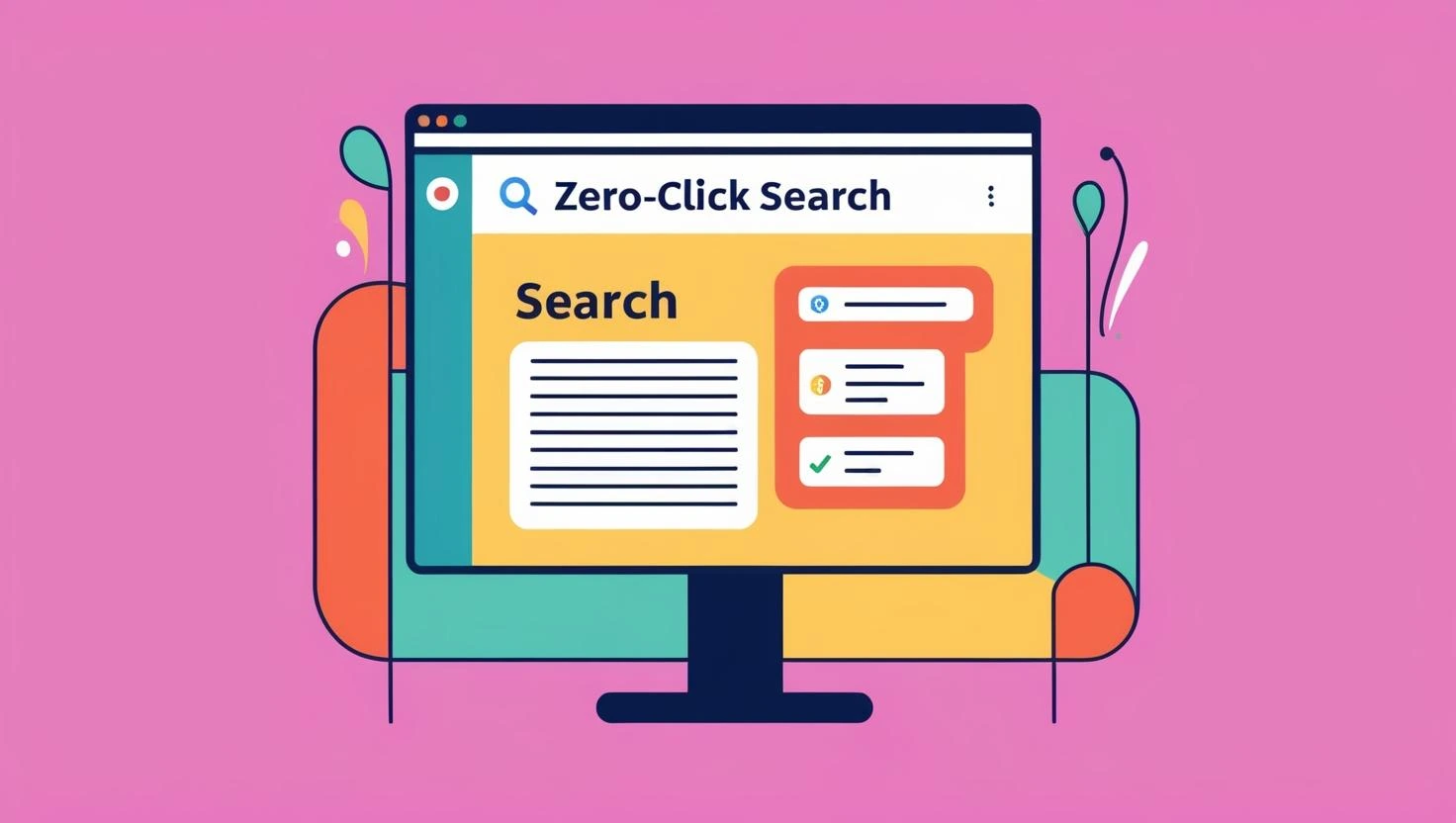
Nothing about this is a penalty or a mistake. It's zero-click search at scale, and most publishers who hit it have no framework for thinking about what to do next. The playbook that works: stop optimising articles purely for clicks and start optimising them for citations. Rebuilding top articles around direct-answer structures, adding FAQ schema, and treating each article as a source to be quoted rather than a page to be visited won't fully recover lost traffic — some of it simply won't come back — but it can hold referral value steady, since citations reach new audiences who then seek out the site directly. The traffic model changes. The business doesn't have to shrink with it.
The number that should stop you in your tracks: 64.82% of all Google searches in 2026 now end without the user clicking on any result. That's not an outlier or a controversial estimate. It's the latest in a trend that has been climbing steadily since 2019, when the zero-click rate was around 50%. Every year, more searches are satisfied entirely on the results page, and 2026 has seen the biggest single-year jump thanks to the aggressive expansion of Google AI Overviews.
Why Zero-Click Search Is Getting Worse, Not Better
The popular narrative is that zero-click search is an AI problem that started in 2024 or 2025. That's wrong, and it's worth correcting because the misdiagnosis leads to the wrong solutions. Zero-click search began accelerating long before AI Overviews. Featured snippets. Knowledge panels. People Also Ask boxes. Local packs. All of these features, which have been expanding since 2015, were already answering queries on the results page without sending clicks anywhere.
What AI Overviews did was dramatically accelerate an existing trend. Queries that previously might have triggered a featured snippet, which at least gave you a chance at a "position zero" click, now trigger a full AI-generated answer that's 200 to 400 words long, synthesized from multiple sources, and positioned above all organic results. For informational queries, which make up the vast majority of search volume, the AI Overview often satisfies the search intent completely before the user sees a single blue link.
Research from SparkToro and Datos confirmed that 58.5% of US searches now end without a click to any external website. For every 1,000 Google searches in the US, only about 360 result in a visit to a website that isn't owned by Google or paid for through Google Ads. The trend will continue. Google's business incentive is to keep users on Google properties as long as possible, and every AI feature they add serves that goal.
Zero-Click Search: The 2026 Numbers
Who Gets Hurt Most (And Who Doesn't)
Before getting into solutions, it helps to understand who is actually affected by zero-click search, because the impact is very uneven and the solution depends on your situation.
Information publishers are hit hardest. Sites that exist primarily to answer questions, how-to guides, definitions, comparisons, explainers, are the main casualties. These are the exact query types that trigger AI Overviews most frequently. If your site makes money through display advertising that depends on pageview volume, this is an existential problem that requires more than tactical adjustments.
E-commerce sites are affected much less. Transactional queries, "buy running shoes size 10," "best price for iPhone 16," rarely trigger AI Overviews. Users shopping need to complete a transaction at a specific destination, so they click. Local business sites are similarly less affected, because local searches typically trigger map packs and local results rather than AI-generated informational answers.
The sites in the middle, brands that use content marketing to drive awareness and leads, face a more nuanced situation. Their top-of-funnel content is losing traffic, but their conversion-oriented content, product comparisons, case studies, direct decision-stage content, may be less affected and potentially even helped by AI Overview citation.
The 7 Strategies That Work in a Zero-Click World
Optimize for citation, not just click
The single most important mindset shift: stop measuring success exclusively by clicks and start measuring by SERP visibility. A brand citation inside an AI Overview that reaches 10,000 query impressions per month delivers brand value even when zero users click. Optimize your content to be cited inside AI Overviews by leading with direct answers, using specific data points, and structuring every section to be extractable independently. Getting cited means millions of users associate your brand name with expertise on that topic, which drives branded search and direct visits over time.
Build your email list as if your traffic depends on it — because it does
Email is the primary hedge against zero-click search. An email subscriber reaches you directly without going through Google. An engaged list of 10,000 subscribers is more valuable than 50,000 monthly visitors from purely informational queries that never convert. Every piece of content you publish should have a clear email capture mechanism: a content upgrade, a lead magnet, a newsletter opt-in that's relevant to what the visitor just read. Build this channel aggressively now. The sites that are resilient to search disruption share one trait: they've built direct audience relationships that don't depend on Google to maintain.
Shift content investment toward conversion intent, not just information intent
Informational queries are where zero-click search hits hardest. Commercial intent queries, "best X for Y," "X vs Y," "how much does X cost," conversion-stage content that moves someone toward a purchase decision, are far less affected by AI Overviews. Google's AI doesn't generally make purchasing decisions for users. It does answer general informational questions. Re-audit your content calendar and shift more resources toward content that targets buyers in the consideration and decision stages, where the click is still necessary for the user to accomplish their goal.
Publish original research and proprietary data
Original data that doesn't exist anywhere else online is the category of content most resistant to zero-click displacement. AI Overviews can synthesize existing information. They can't replicate a survey you ran, a dataset you compiled, or an analysis based on your proprietary customer data. Original research articles become citable sources that other sites link to, that AI systems cite explicitly, and that drive branded traffic from researchers, journalists, and peers in your industry. One solid original study can generate more citation value than 20 generic articles.
Build community around your brand
Discord servers, private Slack groups, membership communities, and YouTube channels are distribution channels that are entirely independent of Google's search results. Building even a small, engaged community of 500 to 1,000 people who care about your topic creates a direct traffic source that zero-click search can't touch. It also creates word-of-mouth distribution. Content shared within a community reaches members without any search intermediary. I'd rather have 2,000 genuinely engaged community members than 20,000 monthly visitors who bounce after reading one article.
Optimize for AI search platforms beyond Google
ChatGPT, Perplexity, and other AI search platforms are growing fast and represent a genuinely new discovery channel. These platforms work differently from Google: they send actual referral traffic when they cite your content. Perplexity users have high click-through rates on citations because the citation is the point, users follow sources to verify and learn more. Building GEO-optimized content that gets cited by multiple AI platforms diversifies your discovery channels away from Google dependency.
Treat your SERP presence as a branding channel
This is the mental model that changes how you report performance internally. If your article appears in an AI Overview that 50,000 people see per month, and your brand name is cited as the source, that's brand exposure. It's not zero traffic. It's a different kind of traffic, brand-building traffic, that doesn't show up in Google Analytics but does show up in branded search volume, in direct traffic trends, and in the "how did you hear about us" field on your contact forms. Start measuring branded search volume in Search Console as a separate KPI. If it's growing while organic clicks are flat or declining, your zero-click strategy is working.
The Reframe That Changes Everything
Here's the data point I wish someone had shared with my friend when she first came to me in a panic: visitors who arrive via AI search citations convert at 23 times the rate of typical organic search visitors, according to BrightEdge cross-industry research covering 1,200 websites. That's not a marginal difference. That's a structural quality advantage.
The mechanism is straightforward. When an AI Overview answers a simple informational query, the users whose intent was fully satisfied by that summary don't click anywhere. They got what they needed. The users who do click through to your site are the ones who want more: they want to verify the AI's answer, explore the topic in depth, engage with the brand, or complete a transaction. They're past the curiosity stage. They're already sold on the fact that your site has useful information. That pre-qualification is what drives the conversion rate advantage.
Zero-click search removes low-intent visitors from your funnel. That sounds bad on a pageview report. It looks very different on a revenue report if you've structured your conversion paths properly. The sites that come out ahead in a zero-click world aren't the ones that fight the trend. They're the ones that build business models designed for higher quality, lower volume traffic combined with strong direct channels that don't depend on search at all.
The one thing zero-click search can't take from you: An audience that came to you directly, either through email, community, or branded search. Every investment you make in building direct relationships with your audience is insurance against every future Google algorithm change, AI expansion, or platform shift. Build that list. Build that community. Do it now, not after the next traffic drop.
My friend with the personal finance site, by the way, ended up in a better position six months after that panicked call than she was when it started. She stopped chasing volume and started building her email list hard. She shifted her publishing focus toward comparison and decision-stage content. She got her most important articles cited in Perplexity for three competitive queries. Her traffic is still lower than peak. Her revenue is higher. That's the real story of zero-click search adaptation done right.